Redlined Arts in Jamaica Plain
Jamaica Plain is often recognized for its vibrant murals and street art, which depict an image of diversity and culture. Yet beneath the surface lies a segregated history shaped by discriminatory housing policy. Over time, the effects of redlining have been unequally dispersed throughout parts of Boston. In neighborhoods like Jamaica Plain, where many Black and Latin American residents have settled, that policy has contributed to segregation. As artists have struggled to obtain and maintain studio spaces amidst gentrification, the neighborhood continues to reflect the spatial inequalities created in the past. Jamaica Plain’s history of redlining has spatially confined marginalized artists to historically disinvested areas, shaping which communities have access to creative space, leaving lasting patterns of displacement that continue today.
Jamaica Plain’s class and racial segregation inevitably led to housing discrimination later on. By the late 1800s, the neighborhood saw substantial population growth, with working class immigrants settling eastward of Washington Street while more affluent populations settled north and west of Washington Street (Aponte). These early divisions foreshadowed the stark boundaries that would later on be enforced through redlining. In 1938, the Federal Housing Administration established redlining, evaluating neighborhoods based on racial compositions (Fig. 1). Areas that had primarily Black populations were marked in red as “D, Fourth Grade” and designated as “hazardous,” while predominantly white areas were labeled “A or B, First or Second Grade” and considered the “greatest” (Aponte). This coding indicated that residents in these redlined areas were denied access to home mortgages and loans, which limited property ownership and prevented them from accumulating wealth. In Jamaica Plain, areas with greater Black and Latin American populations were affected disproportionately by those policies. Because of a lack of financial support, property values were deliberately low and set the landscape for gentrification and displacement that would later occur (The JP Flea). As more Black and Latin American immigrants settled into the area, it was apparent that these marginalized populations were moving into specific areas of the neighborhood where property values were lower and more affordable. These inequalities later extended beyond housing, limiting artistic space for marginalized communities.
Besides preventing property ownership, redlining led to many years of low economic investment in marginalized areas, making them subject to gentrification. By labeling primarily Black neighborhoods as “hazardous,” the Federal Housing Administration stunted property values, forming the basis for later redevelopment. According to Lisa Owens, a tenant advocate, “There were over 4,000 foreclosures in Boston between 2006 and 2011, and more than 80 percent took place in Boston’s historic neighborhoods of color” (Elton). These property losses and evictions accelerated gentrification, as redevelopers acquired and converted them into highly priced luxury housing and office spaces which only the wealthy could purchase. As a result, Black residents moving into Boston were forced into overcrowded and under-resourced neighborhoods where access to mortgages was systematically denied (Elton). As for artists working and living in these areas, the consequences were abrupt. Studio spaces and affordable housing, commonly located in historically redlined sections of Boston, were experiencing closures and redevelopment, with new rents far beyond what working artists could afford. Redlining laid the foundation for later redevelopments that took away many artists’ work spaces. Hence, the displacement of artists in Jamaica Plain reflects the long term structural damage of discriminatory housing policy.
Although federal redlining policies formally led to housing segregation in 1938, artistic exclusion in Jamaica Plain had already begun decades earlier. The establishment of The Footlight Club in 1877 unveils how artistic space was restricted in terms of economic class, which redlining would later amplify. Following rapid industrialization in Boston, members of the professional class, largely white and economically stable people, settled in Jamaica Plain. Due to their undemanding jobs, they sought out recreational activities to fill their leisure time with. This population of people was well educated and consisted of wealthy families that had jobs in publishing, business, architecture, and worked at universities (Campbell). In contrast, Black residents and immigrant populations worked labor-intensive jobs, such as factory work, limiting both their income and free time. Unsurprisingly, twenty-five all white acquaintances in Jamaica Plain founded the Footlight Club as a private theatrical group. Membership of the club required being nominated by one of the existing members and paying dues, all of which restricted participation to affluent people (Campbell). Because of this tie of artistic participation to wealthy social networks, moderated access to theatrical activities indicated the divide in the neighborhood. In addition, the club’s performance hall on Eliot Street was located in an area that would later on not be designated as red, presenting how the arts were in alignment with white residential and economic stability (Fig. 1). Before federal housing maps even redlined specific areas of Jamaica Plain, artistic opportunity in the neighborhood was already limited to wealthy white people. Although the Footlight Club continues to operate today and is now run by volunteers, its origins in a privileged white setting reinforced emerging economic and racial divisions in Jamaica Plain. Rather than providing inclusive artistic access, the club shaped who could explore and participate in the arts, foreshadowing the spatial inequalities redlining would later formalize.
In response to exclusion from predominantly white artistic spaces, impactful figures such as Maud Cuney Hare created an alternative organization that specifically served marginalized communities in what would later become a redlined area. Cuney Hare, a musician whose career reflects the barriers Black artists faced in the 1900s, confronted racial exclusion. After arriving in Boston in 1890 at the young age of sixteen to study at the New England Conservatory, she encountered hatred from white students who insisted that she leave the school (Neal). While she did ultimately graduate, the difficulties she faced emphasized that access to artistic institutions did not guarantee racial inclusion. Rather than seeking inclusion in predominantly white artistic spaces, Cuney Hare founded the Allied Arts Centre in 1927 to create an alternative art space for Boston’s Black community (Neal). Unlike the Footlight Club, which restricted membership through biased nominations and employing financial constraints, the Allied Arts Centre aimed to expand musical access to Black youth. Cuney Hare’s Allied Arts Centre was described as, “Under her direction, the center held lectures, concerts and classes in music, dance, voice and drama, and embraced a children’s ‘little theatre’ in Boston’s black community,” and the organization also “provided ‘a space for art, theatre, music, lectures, workshops, and more’” (Neal). Cuney Hare created a space where Black artistic expression could bloom independently, in an area isolated from primarily white institutions. Just as other organizations that serve marginalized communities did, the Allied Arts Centre operated within areas that would later be redlined (Fig. 1), as other parts of the neighborhood and city did not provide inclusive spaces. Maud Cuney Hare’s work therefore showcases both artistic achievement and structural constraint; her organization expanded artistic opportunity, yet it existed within what would later become boundaries imposed by discriminatory housing.
The vulnerability of Black artistic space in Boston persisted into the late 1900s as evident by the journey of the AAMARP, or African American Master Artists-In-Residence Program. Developed in the 1970s following an incident when Black artist Dana Chandler’s studio in the South End was destroyed after a break-in (Mason), the AAMARP was founded in collaboration with representatives from Northeastern University to provide studio space for Black artists who had been excluded from the “mainstream art world” (Mason). Gregory Ricks, director of the African American program at Northeastern, took Chandler to an unused college building at 11 Leon Street in Jamaica Plain, part of a historically redlined area (Fig. 1). There, they created the AAMARP, which supplied artist studio space for free. But it was not smooth sailing from here; aside from budget cuts in 1993, in 2018 Northeastern locked out artists and issued a notice for members of the AAMARP to leave their Jamaica Plain studio space, due to “hazardous conditions” in the building (Mason). This inevitably led to a protest outside of the Jamaica Plain studio, which shone light on how authority figures have historically framed Black occupied spaces as dangerous with no valid reasoning. The attempted displacement of the AAMARP makes clear how redlining’s effects extend beyond residential segregation and that artistic space in marginalized areas continues to falter. The AAMARP’s fragility indicates the long term consequences of discrimination, in which historically redlined areas remain subject to displacement.
A major consequence of historical redlining is the fact that communities today are still limited to residing in areas that were designated red in the past. The Hyde Square Task Force, founded in 1991 by a group of neighbors in Jamaica Plain, operates primarily in the Hyde Square and Jackson Square areas of Jamaica Plain. By aiming to preserve culture and encouraging artistic exploration among youth, the organization has worked to sustain Afro-Latin artistic presence in a neighborhood increasingly affected by rising housing costs (Hyde Square Task Force). In 2016, Hyde Square Task Force began managing the Latin Quarter, which was officially designated as a cultural district in 2018 (Hyde Square Task Force). The designation sought to acknowledge and uplift the culture of Latin American immigrants in Jamaica Plain amid their vulnerability to displacement. The organization purchased “the former Blessed Sacrament church, a historic landmark that had been vacant for ten years and was slated for redevelopment as market rate housing” in 2014, to convert it into “fifty five units of affordable housing,” which included a large performance space (Hyde Square Task Force). While the Latin Quarter significantly contributed to the art scene and promoted opportunity, it still, along with the housing project and performance space, is in a historically redlined area. This exemplifies the inability for these marginalized groups to intersect into the larger community, limiting their cultural and creative space to areas like Hyde and Jackson Square which are targets for redevelopment. In response to this issue, the founders of Hoopla Productions, a nonprofit musical organization in Jamaica Plain, say “While we don’t pretend to solve these enormous problems, we believe that giving people an opportunity to come together across differences–and to express their struggles through spoken word, music, theatre and more–is a small step toward creating a better world” (Swenson). While such efforts like Hoopla Productions promote inclusion, their founders have acknowledged that developing organizations alone cannot resolve the deeper housing inequities driving displacement, “Even though we are diverse, even though this is a neighborhood that is considered tolerant, accepting and protective of people who are marginalized it is still partially segregated by class, race, and culture” (Swenson). When first developing JP Porchfest, Hoopla Productions received solely white participant interest after advertising in the central part of the neighborhood, which reflected the divided nature of the neighborhood. To address this, the founders described, “We hired a Latino Outreach Coordinator, a musician who successfully increased participation within two primarily Latino parts of the neighborhood” (Boston Voyager). The need to intentionally recruit artists of color from parts of the neighborhood like the Latin Quarter, and the need to address gaps in participation demonstrates how segregation persists beneath the surface of Jamaica Plain’s artistic communities. Even in a seemingly inclusive arts organization, participation reflects the boundaries that still linger from historical redlining, continuing to shape the neighborhood’s art scene.
In response to the displacement produced by the enduring effects of housing discrimination, activists in Jamaica Plain have used art itself as a tool to educate people of the neighborhood's segregation history. In 2015, members of City Life/Vida Urbana carried out a unique project; walking through Boston’s neighborhoods from Jamaica Plain to Dorchester, marking the streets with red chalk made from recycled demolition bricks (Houseman). The project symbolically retraced the confines of historically redlined areas, making the history of redlining visible to the public. During the time of this project, the entirety of neighborhood blocks were being converted into housing complexes, and the city was very clearly divided from the Federal Housing Administration’s historical policies (Houseman). In response, City Life/Vida Urbana created an “eviction free zone,” which helped over 800 families maintain their homes (Houseman). Amid rising evictions and redevelopment, the redlining chalk project functioned as a form of resistance, revealing how artistic expression in Jamaica Plain was used to respond directly to the inequalities created by redlining. By physically marking the neighborhoods, members utilized public space as a canvas to bring to the surface historical redlining and its long-term consequence of gentrification. Redlining did not simply produce residential segregation; it continues to shape who can live in Jamaica Plain, thus confining cultural spaces for marginalized communities.
The displacement of artists in and around Jamaica Plain further displays how redlining’s long-term effects continue to shape the neighborhood’s art scene. In more recent years, studio buildings that once provided affordable space for musicians and visual artists have been redeveloped into commercial houses and luxury housing. One such instance in 2018 was the eviction of three hundred artists and musicians from the New Alliance Audio community’s building in Cambridge, in which numerous performances and exhibits had taken place (Donner). Artists were told they needed to vacate the building due to safety concerns, despite later official inspections finding no safety issues (Donner), just as what occurred with the AAMARP. This incident did not only occur in one case, as evictions happened to many more artists in Jamaica Plain and surrounding neighborhoods. The one crucial piece they all had in common? Every single one of these buildings was located in historically redlined areas (Fig. 1), and were redeveloped into lavish housing and professional spaces. Artists were forced to move out after eviction notices were sent, and due to rent prices in the area which were significantly higher than what they were originally paying, many artists left Jamaica Plain altogether (Ertischek). Similarly, a music rehearsal studio in Brighton called “The Sound Museum” likewise displaced seven hundred musicians in a redlined area subjected to gentrification (Fig. 1), which was later redeveloped into six story buildings (Mason). During this time, a mass conversion of arts spaces into commercial buildings was taking place. Artists who once worked in inclusive spaces where housing and studio space was more affordable were forced to relocate, many of the artists leaving Boston for more affordable places. These patterns show that areas which were once denied financial support and depreciated in property values later became targeted sites for redevelopment. Ongoing gentrification in Jamaica Plain continues to determine not only who lives in certain areas of the neighborhood, but also who has access to creative space within it.
The history of redlining in Jamaica Plain reveals how access to creative space has been directly influenced by patterns of racial and economic inequality. Redlining determined which communities economically diminished, which later became targets for redevelopment, and ultimately influenced which people could afford to live in these areas and produce art. From professional class white art organizations in the 1800s to the displacement of marginalized arts organizations and studio evictions more recently, access to artistic space has consistently mirrored inequality in the neighborhood and beyond. Organizations located in historically redlined areas have remained confined to specific parts of the neighborhood, highlighting the persistence of these long-standing divisions. Without change, Jamaica Plain’s art scene will continue to mirror the same structural inequities redlining first established.
Works Cited
Aponte, Andrea. “Jamaica Plain: A Racialized Landscape – Cities, Landscape, and Modern Culture.” Northeastern University Library, 2018, https://landscapes.northeastern.edu/andrea-apontes-page/.
“Boston’s Latin Quarter.” Hyde Square Task Force | Boston, 10 Feb. 2020, https://www.hydesquare.org/bostons-latin-quarter/.
Donner, Becky. “Artscope Magazine: A Call to Protect Our Cultural & Creative Spaces — #ARTSTAYSHERE.” Art Stays Here, 1 May 2023, https://www.artstayshere.org/news/hv9rf9x3ob56fimydj71bx6i8g635e-axkky-5n7z3-wdaw9-ntel8-tatk8-jrz3j-5fatb-hx75d-mas8a.
Elton, Catherine. “How Has Boston Gotten Away with Being Segregated for So Long?” Boston Magazine, 8 Dec. 2020, https://www.bostonmagazine.com/news/2020/12/08/boston-segregation/.
Ertischek, David. “The Changing Character of JP: What Does It Mean If the Artists Move Away?” Jamaica Plain News, 29 Jan. 2018, https://jamaicaplainnews.com/2018/01/29/the-changing-artistic-character-of-jp-if-the-artists-move-away-can-there-still-be-jp-open-studios/30471.
“Evolution of Jamaica Plain - From Suburb to Cultural Hub.” The JP Flea: A Jamaica Plain Artisan Marketplace, 19 Jul. 2024, https://jpflea.com/the-evolution-of-jamaica-plain-from-streetcar-suburb-to-cultural-hub/.
Home Owners’ Loan Corporation, and George F. Cram Company. Residential Security Map of Boston, Massachusetts. 1 Feb. 1938, https://collections.leventhalmap.org/search/commonwealth:00000x52b.
Houseman, Haley ED. “Artists and Activists Trace Boston’s Historic Red Line on the Streets.” Hyperallergic, 22 Sep. 2015, https://hyperallergic.com/artists-and-activists-trace-bostons-historic-red-line-on-the-streets/.
Jamaica Plain Historical Society. “The Footlight Club at 125 Years — Jamaica Plain Historical Society.” Jamaica Plain Historical Society, 2 Jan. 2004, https://www.jphs.org/victorian-era/the-footlight-club-at-125-years.html#gsc.tab=0.
Mason, Amelia. “WBUR.” WBUR News, 29 Jun. 2020, https://www.wbur.org/news/2020/06/29/black-artist-collective-locked-out-of-studios-at-northeastern-university.
Neal, Anthony. “Maud Cuney-Hare: Lifting the Race through the Arts.” The Bay State Banner, Ronald Mitchell, 7 Nov. 2012, https://baystatebanner.com/2012/11/07/maud-cuney-hare-lifting-the-race-through-the-arts/.
Boston Voyager. “Meet Marie Ghitman and Mindy Fried of Hoopla Productions/JPPorchfest in Jamaica Plain.” Boston City Guide, 2 Jan. 2018, https://bostonvoyager.com/interview/meet-marie-ghitman-mindy-fried-hoopla-productionsjpporchfest-jamaica-plain/.
Swenson, Sally Sally Swenson. “JP and Mindy Fried & Marie Ghitman.” Jamaica Plain Neighborhood Development Corporation, 17 Aug. 2017, https://jpndc.org/jp-and-mindy-fried-marie-ghitman/.
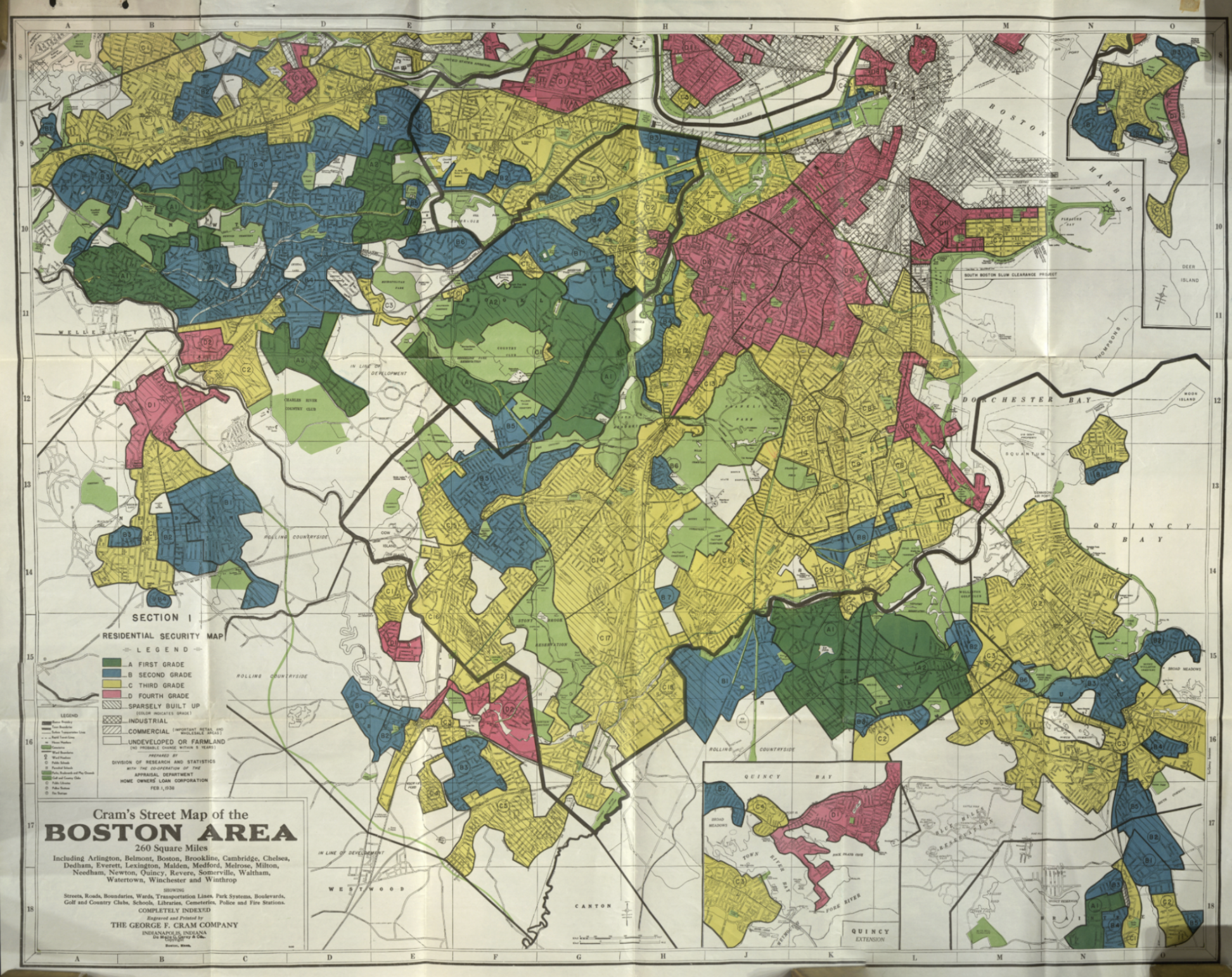
Fig. 1 The George F. Cram Company. Residential Security Map, Cram’s Street Map of the Boston Area. 1 Feb. 1938, https://www.segregationbydesign.com/boston/redlining.