Local Food, Local Impact: The Somerville Winter Farmers Market
By Julia Galvagna
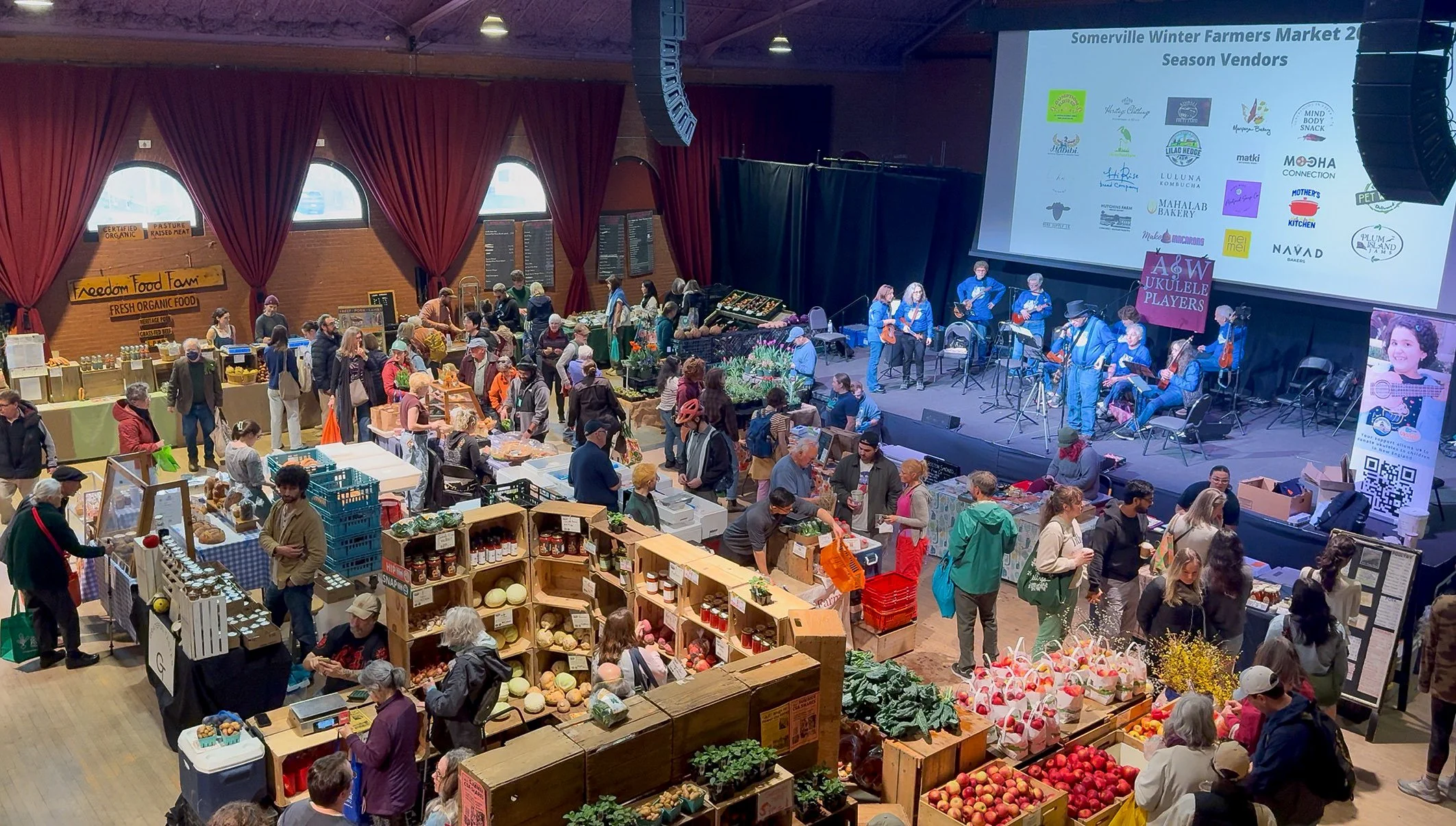
The Somerville Winter Farmers Market ground floor, April 4th, 2026. Photo by Author.
Even on the coldest of Saturday mornings, a small but bustling farmers market operates in Somerville’s Center for Arts at the Armory (CAA), where about 30 vendors gather for the Somerville Winter Farmers Market (SWFM). Upon entering, buyers are greeted by warmth and a lively atmosphere of transactions and friendly conversation as fellow shoppers inspect products. The market entrance guides customers to its mezzanine, providing an outlook over the market stage and ground floor, where mainly produce, fresh meats and fish, and baked goods are sold. Every week, the market hosts live musicians. On April 4th, A&W Ukulele Players performed on the market stage, receiving enthusiastic applause after every song. “Everyone is just so friendly and the customers are great,” said Jenna, the farmers market manager for Hi-Rise Bread Company. Despite only coming to Somerville for the SWFM on Saturdays, she has had an incredible experience selling. “It’s just a really, really good environment here. I've never had a bad experience coming here to sell, so it’s been fantastic.”
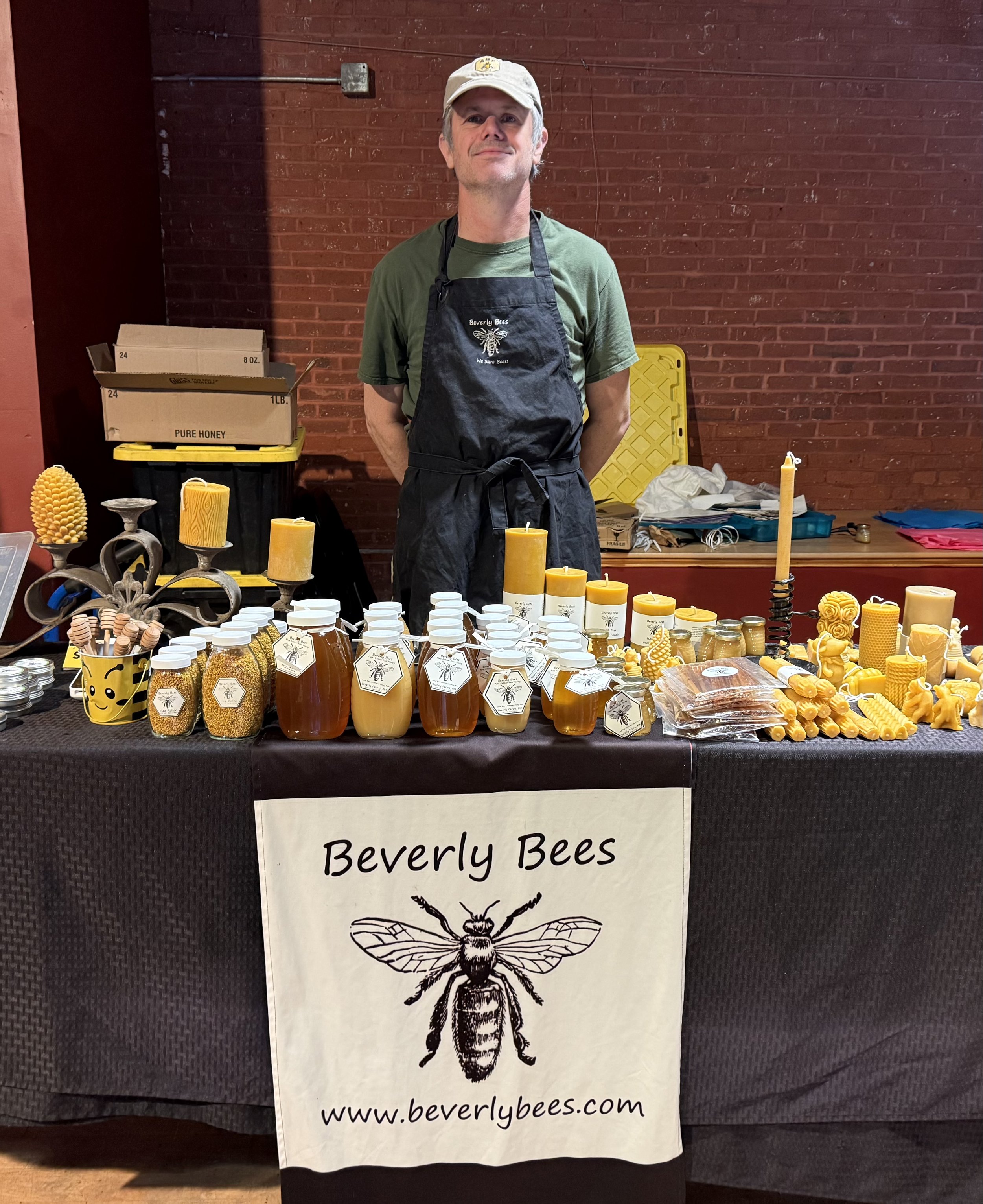
Brian Deeley of Beverly Bees stands at his stall in the CAA. Photo by Author.
Jenna’s experiences at the SWFM reflect the goals of the CAA; a non-profit organization that strives to create inclusive opportunities for artists and cultural workers, enriching the lives of Somerville residents and celebrating the cultural diversity that constitutes the city. The SWFM is one of its five signature programs: a weekly winter market that hosts over 65 local food vendors from November through April every year. Juliana Soltys, the SWFM’s Market Manager over the last four seasons, maintains that “the community is very supportive of the farmers market and appreciates the rich community environment during the cold months and having access to fresh fruits [and] veggies.” In fact, the market came to Somerville in January of 2011 in response to a community need for more fresh and local foods during the winter. The SWFM has run every winter since, even converting to an outdoor, pre-order market during the COVID-19 outbreak to continue supporting producers and consumers. “Somerville is awesome for me,” expressed Brian Deeley, co-owner of Beverly Bees, based in Beverly, MA. Before the pandemic, Deeley vended at seven or eight markets a week. Once the pandemic hit, many farmers markets were shut down; upon their reopening, Deeley claimed he now only vends at the best markets he can find, asserting confidently that “it’s Somerville.”
The SWFM aims to strengthen the relationship between producers and consumers by increasing access to healthy, local food and products for all customers—including the city’s middle and low-income residents—in a way that still contributes to the year-round success of producers. The market supports customers who are part of the Supplemental Nutrition Assistance Program (SNAP), which provides benefits to low-income individuals and families via an Electronic Benefits Transfer (EBT) card to supplement their grocery budget. In 2023, 1 in 6 Massachusetts residents, or 667,000 Massachusetts households, received SNAP benefits. In Somerville alone, 8.3% of the population used SNAP, totalling to 6,474 clients. Soltys shared that “As one of the largest winter farmers markets, we've also seen an increase in the number of SNAP customers and have set a record this season with our $15 SNAP Match, matching over $30k total.” Additionally, the SWFM participates in the Healthy Incentives Program (HIP), which assists customers in buying more locally grown fruits and vegetables; if a customer purchases fruits and vegetables with SNAP at participating farmers’ (or related) markets, they will then earn extra money back onto their SNAP/EBT card.
Vendor Chris Haskell, co-founder at the Amherst Mushroom Company in western Massachusetts, shared, “I live two hours west of [Somerville] and this is by far one of the best communities in the state.” Haskell described how during COVID-19, he and his fellow founders began a company for food delivery, and their biggest supporters were local to Amherst, Northampton, and Somerville, further adding that “It’s just a different place here, it’s worth the two hour drive…it’s a really supportive community.” When asked what makes Somerville so special and supportive, Haskell noted that the city is full of “a bunch of young people that have needs” and that there are “a lot of people in the tech industry, it’s an affluent community, far and large, and they do support the people that aren't as well, so, like, the SNAP program here is bumping, and, like, the response from the HIP program here has been, like, more than in other places,” he said. “Some people can spend a lot more for, you know, a dozen eggs or a pound of honey. So, it makes stuff like [the SWFM] able to be a thing.”
Matt—one of the other farm stand vendors at Amherst Mushroom Company—lives in Somerville and has been helping mushroom companies in Western Massachusetts for the past three years. “Matt’s the local guy!” quipped Chris, eliciting a smile from Matt. “I’m the local guy!” he exclaimed, “I see a lot of the same people…around the city. Like, if I’ve seen someone that, like, is either a volunteer at the farmers market or just, like, a customer, we always, like, say ‘hi’ to each other on the community path, or maybe we’re, like, watching the same movie at the Somerville theater…It makes me feel like the city is, like, a bit smaller, even though…so many people live here.”
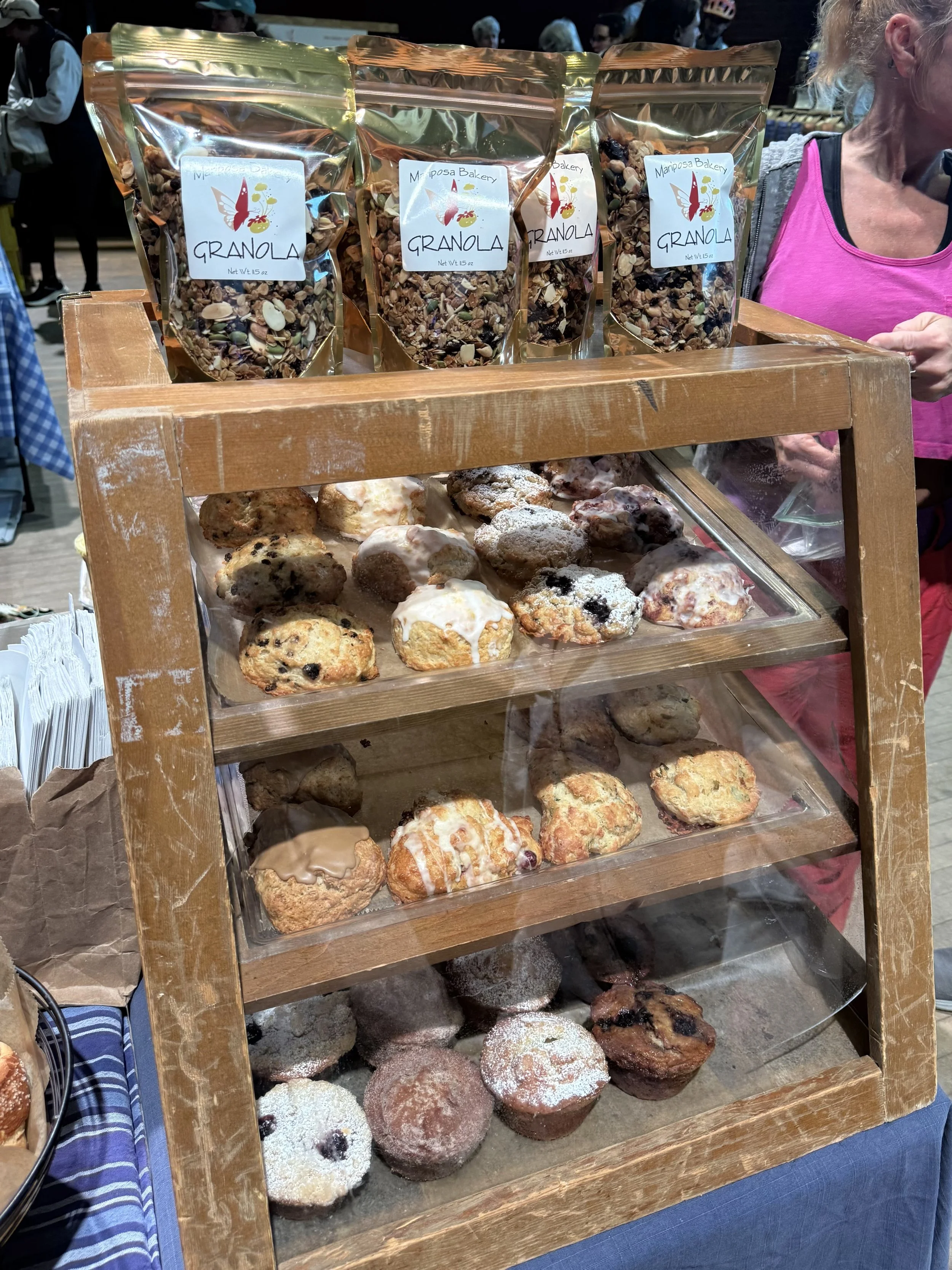
Mariposa Bakery display case of scones and muffins. Photo by Author.
Around the corner from Amherst Mushroom Company were Sofia and Ray of Mariposa Bakery. Sofia, a senior attending Somerville high school, shared how vendors like herself not only have positive interactions with customers, but with fellow vendors, too. During the hour and a half vendors are given to set up shop, they have the chance to get to know one another and develop pleasant workplace relationships. “I love him so much,” she gushed, gesturing to the vendor at Nibble Kitchen, “he’s awesome, he gave us little stickers today…he was like, ‘hi pretty girls!’ Like, he's so sweet.” She then began to describe the trading process that occurs after the market has shut down for the day, noting how fun it can be as vendors intermingle. “I just didn't expect it to be that much of a community,” she confessed. “Because we’re a bakery…we have, like, a whole bunch of scones, and if we have some extra pretzels or extra cookies, we’ll give one of the farmers, like, some of, like, those pastries, and then they’ll give us, like, leeks or kale…we get a lot of mushrooms from, like, mushroom guys and we use those back at the bakery for our frittattas,” reflecting on the sustainable nature of the market, even between vendors.
Similarly, Jim from SA’s Homestyle Sweet and Spicy Sauce stated, “I love the interaction and I especially like the fact that we have a product that people really like and enjoy and continue to purchase,” and that the most rewarding part is getting to experience customers enjoying his product by taste-testing his sauce on a potato chip. However, when asked about whether he agrees that Somerville is a great community for being in a farmers market space, his opinions lie in-between. “Yes and no,” he answered, “I…find that Somerville is sort of like a transient community…In the sense that a lot of students come and go, people come and go, [and] there’s a huge rental population that turns over all the time, so oftentimes I feel we [sellers] have to almost start fresh, in a way. But, you always retain the customers that really like your product, so it’s all good.”
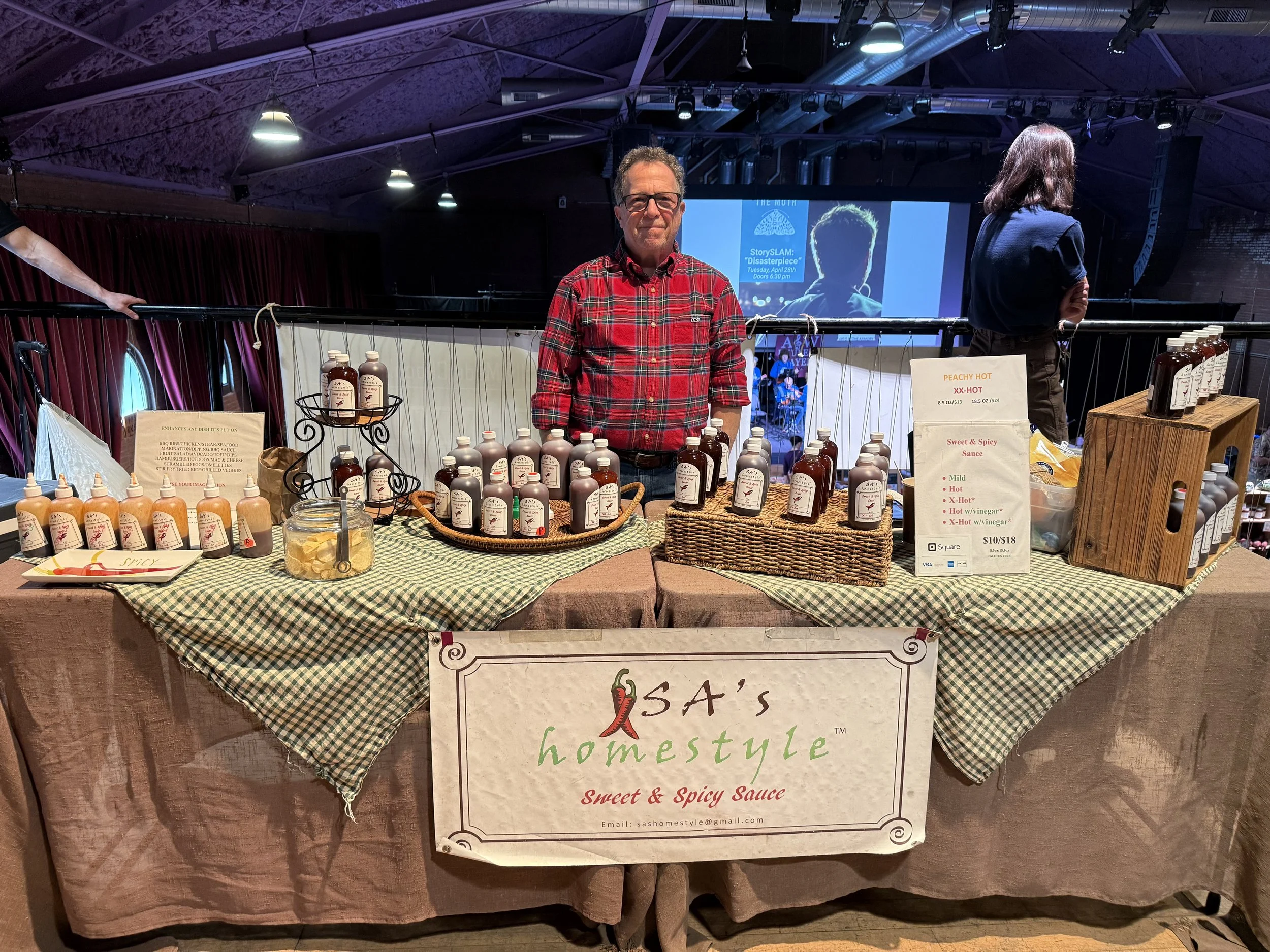
Jim of SA’s Homestyle Sweet & Spicy Sauce at his stall on the mezzanine. Photo by Author.
Sarah Carlisle of Rascal Relish holds a similar perspective to Jim when it comes to Somerville’s community interaction. She noted how the number of college students in Boston drops as they travel home during the summertime and winter, reducing Somerville’s population of devoted farmers market attendees. As a result, Boston-area farmers markets are often treated as a novelty by passers-by, especially at the SoWa Open Market, which runs from May through October. “The people who are walking through are people going to and from brunch…they’re treating farmers markets as an activity and not a legitimate marketplace where tons of businesses are coming to try to make money.”
When considering community support for farmers markets, she remarked, “I think it’s a wonderful community when [the] community shows up to support small businesses.” The weeks when customers do not show up can be really difficult for small businesses, who require their presence to make a living. Carlisle has done a lot of reflection on how consumers tend to see farmers markets as a “third space” or “park” that one can walk through and admire, rather than actively engage with or use as an opportunity to support local businesses. “It’s wonderful when it works, you know?” she offered, “And ‘works’ means that, like, everybody shows up on time, everybody’s kind to each other, and people come to shop, and then if one of those pieces is off, then it can be a really hard way to try to make money.” According to Carlisle, the past season was one of the “worst winters for a small business,” due to issues in the economy and people in general not taking small businesses seriously.
Looking ahead to next winter, Soltys wished the market could support more businesses who are just starting out, especially vendors who want to test product sales or don't have the resources to start their own business. She also hoped that someday the market would have an incubator program to assist aspiring business owners. Overall, the market’s goals are to “continue to serve the Greater Boston community, provide fresh and diverse offerings to customers, connect producers directly to customers, and foster a welcoming [and] inclusive environment.”